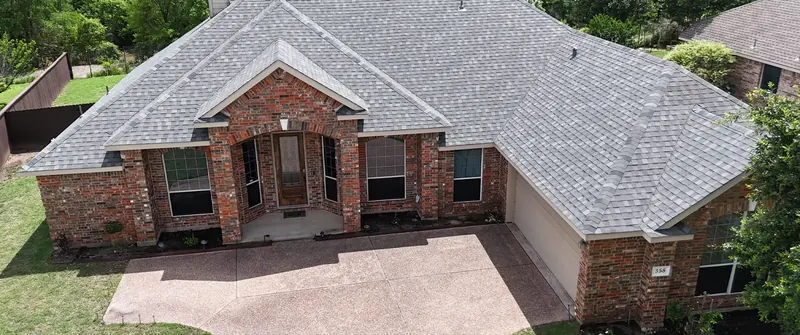
Roof Replacement in Fort Worth
Plan your Fort Worth or Dallas–Fort Worth roof replacement with a condition assessment, material comparison and written construction scope. Start by understanding what your property needs.
Should you repair or replace your roof?
SkyGuard Roofing Solutions is based in Fort Worth and serves properties across DFW. We assess visible roof conditions, known leaks, earlier repairs and the existing assembly before discussing replacement. A localized flashing problem or damaged area may have a practical roof repair option. Widespread deterioration, recurring problems or damage that cannot be reliably repaired may support a replacement plan.
Age alone does not settle the decision. Ask what was inspected, which findings support the recommendation and what remains concealed. For a business or a building with a low-slope roof, our commercial roofing assessment addresses drainage, equipment and occupancy requirements.
What affects roof replacement cost in Fort Worth?
A useful estimate reflects the actual roof rather than a generic price range. Compare these items across proposals:
- Roof size and layout: measured area, height, slope, valleys and access affect the work.
- Removal and preparation: existing layers, disposal, deck condition and any approved repairs.
- Material and details: the named roof product, underlayment, flashing, ventilation and accessories.
- Project conditions: required approvals, property protection, staging and special access needs.
Ask how additional decking damage will be documented, priced and authorized. Separate optional upgrades from the base scope so a lower headline price does not hide different work. We confirm costs after assessing the property.
Compare roofing materials and complete systems
Architectural asphalt shingles
Compare the specific product’s appearance, technical requirements and written warranty. Architectural describes a shingle style; it does not establish one impact rating or warranty for every product. Our TAMKO Pro Gold credential and CertainTeed ShingleMaster credential provide context when discussing those manufacturers’ systems. Confirm the exact products and coverage in your proposal.
Impact-rated shingles: Class 3 versus Class 4
Under UL 2218, impact classifications run from Class 1 through Class 4, with Class 4 the highest class. GAF’s impact-testing explanation describes a larger steel ball and greater drop height for Class 4 than Class 3. These are laboratory classifications, not a required shingle ingredient or backing. Ask for the exact product’s current rating and installation documents; neither classification means hail-proof.
The Texas Department of Insurance impact-resistant roofing guidance explains that insurers set their own accepted criteria, paperwork and discount amounts. Confirm eligibility directly with your insurer before including savings in your budget. There is no universal discount percentage.
Stone-coated steel and standing seam
TEK is our main stone-coated steel product line. Explore stone-coated steel roofing for shake, tile and shingle profiles and product-specific installation considerations. Standing seam presents a different panel layout and attachment approach. Our metal roofing comparison helps frame the choice; contact us to confirm available installation options and project scope before planning a standing-seam roof.
When does Fort Worth require a roofing permit?
The City of Fort Worth’s residential permitting guidance covers detached one- and two-family homes and their accessory structures. For those properties, shingle work alone does not require a building permit, while replacing decking, lathing or sheathing boards, rafters or ridge boards does. The city also limits the number of shingle layers.
Confirm the full scope with the city, including any concealed damage discovered during removal. Material changes, historic-property review and HOA requirements also need attention. Other DFW jurisdictions may have different requirements. Our Fort Worth roofing page links additional local resources.
Decking, flashing and ventilation belong in the scope
A roof covering needs an appropriate substrate and installation details. The city’s roofing FAQ explains that sound sheathing that complied when originally installed does not automatically require complete replacement because codes changed. Document damaged or unsuitable decking and agree on repairs before covering it. Specify how valleys, walls, roof edges and penetrations will be addressed. Low-slope sections may need a different covering from the main roof.
Review whether the attic is vented or uses a designed unvented assembly. For a vented attic, assess both intake and exhaust alongside the selected system’s requirements. Adding vents without understanding the assembly is not a complete plan. Use the actual manufacturer’s instructions for deck suitability, fastening, underlayment and accessories; GAF’s installation resources illustrate why these components need coordinated details.
Replacing a roof after an insurance claim
SkyGuard can inspect, photograph observations and prepare a construction estimate. You handle the claim with your insurer; we do not file claims, negotiate settlements or represent you on coverage questions. Ask your insurer about policy deadlines, deductibles and required documentation.
Texas prohibits contractors from waiving, rebating or absorbing a policyholder’s deductible. Review the TDI roofing and insurance guidance and our storm-damage assessment process. Keep construction changes in writing and ask your insurer how to submit additional documentation; a change order does not determine coverage.
A clear replacement process
- Inspect and compare: review condition, repair options, measurements and material preferences.
- Agree on the scope: document products, preparation, approvals, payment terms and how changes are authorized.
- Prepare for work: discuss delivery, weather, property access, protection and scheduling.
- Install and document: follow the selected system’s requirements and record approved additional work.
- Close out: review cleanup, project records, applicable inspections, warranty documents and follow-up contacts.
Request manufacturer coverage and any contractor workmanship terms separately before signing. Ask about registration, exclusions, maintenance and transfer conditions. A long warranty term does not guarantee the roof’s lifespan, and a contractor credential alone does not establish every project’s warranty eligibility.
Roof replacement questions
How long will replacement take?
Timing depends on roof complexity, preparation, product availability, approvals and weather. Ask for a project-specific schedule and how delays or uncovered damage will be communicated.
Can we stay home during the work?
Discuss noise, driveway access, pets, children and any sensitive equipment before scheduling. Your property and work scope determine the arrangements; agree on access restrictions with the project team.
Is financing available?
Review our financing information and confirm current options. Approval and terms depend on the provider and applicant. Keep the roofing estimate separate from the credit decision.
Plan your Fort Worth roof replacement
Tell us your city, roof concerns and material preferences. We will follow up to discuss inspection access and the next steps for your Fort Worth or DFW property.